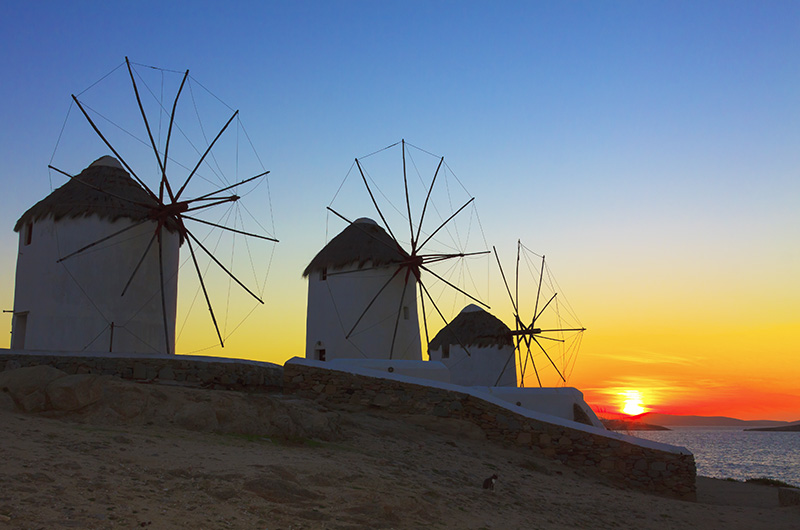
Few sights imprint themselves on memory quite like the Mykonos Windmills. Rising above cobalt waters and sunlit rooftops, these whitewashed silhouettes command the skyline with calm authority, echoing centuries of maritime trade, agricultural labor, and Cycladic resilience.
Long before beach clubs and luxury yachts defined the island’s rhythm, sails filled the horizon and grain dust perfumed the air around these towers of stone and timber.
To stand among them today is to trace the pulse of Mykonos Greece, guided by wind, sea, and stories carried across generations. This is a journey through architecture, craftsmanship, survival, and landscape, written by nature and shaped by human ingenuity.
The Birth of the Mykonos Windmills and the Island of Winds
The northern Aegean breeze known as the Meltemi sculpts daily life on Mykonos. It explains the island’s low vegetation, protective courtyard walls, and the strategic positioning of its mills along exposed ridges. From the sixteenth century onward, Venetian builders recognized the island’s potential, erecting circular stone towers crowned with wooden sails designed to catch every gust.
For centuries, these mills ground barley and wheat harvested locally or shipped in from neighboring islands. Their output fueled bakeries, supplied sailors with durable rusks called paximadi, and transformed Mykonos into a key provisioning stop for ships navigating the Cyclades.
At their height, more than twenty five windmills dotted the island. Today, sixteen remain, restored and preserved as enduring witnesses to a working seascape that once hummed with rotation and grain.
The Architecture and Mechanics Behind the Mykonos Windmills
Cycladic windmills followed a strict functional blueprint. Each rose three levels high, constructed from thick stone to anchor them against relentless winds. Small windows reduced pressure and heat, while pointed wooden roofs sheltered the central axis that transferred movement from sail to grindstone.
Twelve wooden arms extended from the roof, each fitted with triangular cotton wings similar to ship sails. When wind struck, the entire cap rotated toward its source, turning a vertical shaft that powered massive millstones on the upper floor.
Below, flour was collected and weighed, while the ground level stored raw grain and finished product. Every architectural detail served efficiency, forming a compact manufacturing unit long before electricity reshaped island economies.
The Legendary Cluster at Kato Mili
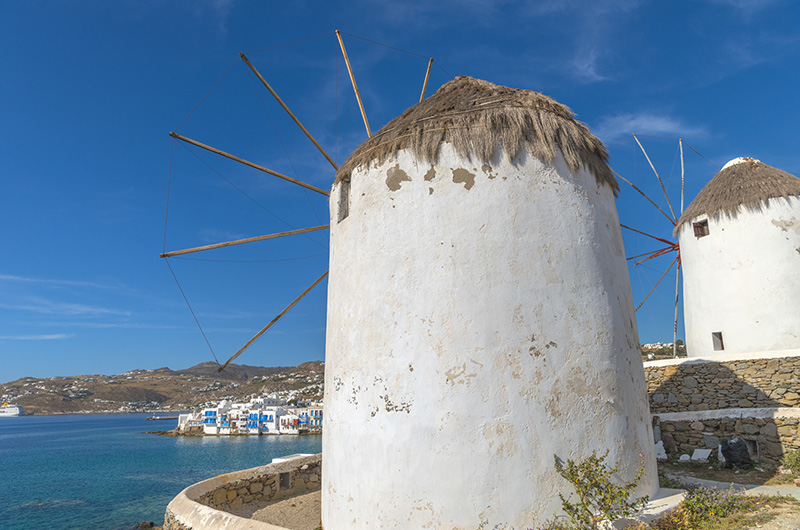
Seven of the most photographed mills crown the slope known locally as Kato Mili, poised between the harbor of Alefkandra (Little Venice) and the Neochori neighborhood near Mykonos Town. Facing the sea, they once formed part of a larger complex of ten or eleven working mills whose combined output dominated flour production in the region.
From this vantage point, the Aegean unfolds in luminous blues while boats glide past Little Venice’s balconies. Sunrise offers hushed streets and pale pink skies. Sunset ignites stone and sail alike in amber and copper. Wandering here means following narrow pedestrian lanes lined with painted doors, curved staircases, and lazy cats basking in late light.
This dramatic meeting of architecture and horizon explains why the Mykonos Windmills became one of Greece’s most recognizable images, a symbol woven into postcards, canvases, and memories carried home by travelers.
Geronymos Mill
Dating back to 1700, Geronymos Mill continued producing flour until the 1960s. Its recent restoration preserved most of the original grinding mechanism, offering insight into how wind energy powered daily sustenance.
Although interior access remains limited, the exterior frames sweeping sea views and neighboring mills, with a small art and jewelry shop housed in what once served as storage.
Boni’s Mill
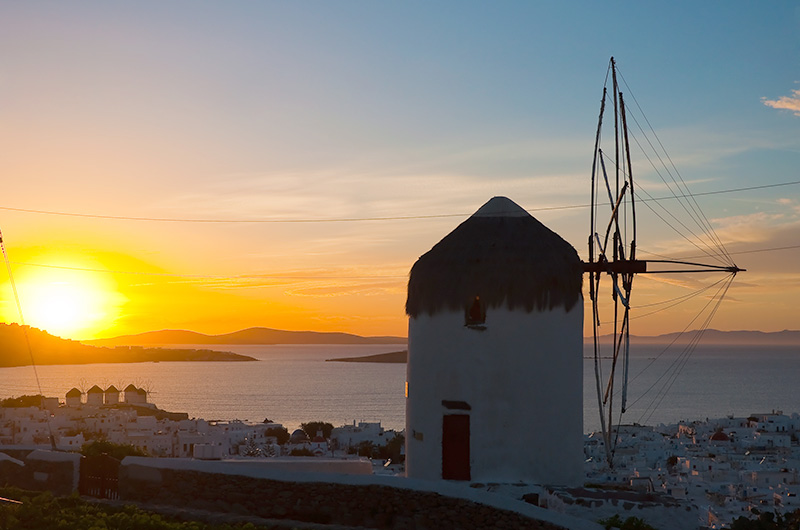
Boni’s Mill forms the heart of Mykonos’ Agricultural Museum and stands on a hilltop overlooking Chora. Visitors climb all three floors, observing the complete milling cycle from grain intake to weighing and storage. Around the tower stretch supporting structures such as a threshing floor, dovecote, grape treadle, water well, and wood fired oven, reconstructing a self sufficient rural household once called a horio.
The mill belonged to its final owner, George Bonis, before entering the museum collection in 1962. Each September, during the Harvest Festival, locals and guests gather here for kerasmata, folk music, dancing, and storytelling, reviving seasonal rituals rooted in communal labor.
From Industry to Icon
Electricity eventually rendered wind powered milling obsolete, and by the mid twentieth century the sails fell silent. Several towers became private homes, others cultural monuments, all protected as architectural heritage.
Yet their influence endured. The Mykonos Windmills reveal how the island balanced scarcity with innovation, turning climate into advantage and geography into livelihood. They chart a timeline from subsistence agriculture to cosmopolitan destination, where old stone towers now overlook marinas and designer boutiques.
Staying Close to History in Tourlos
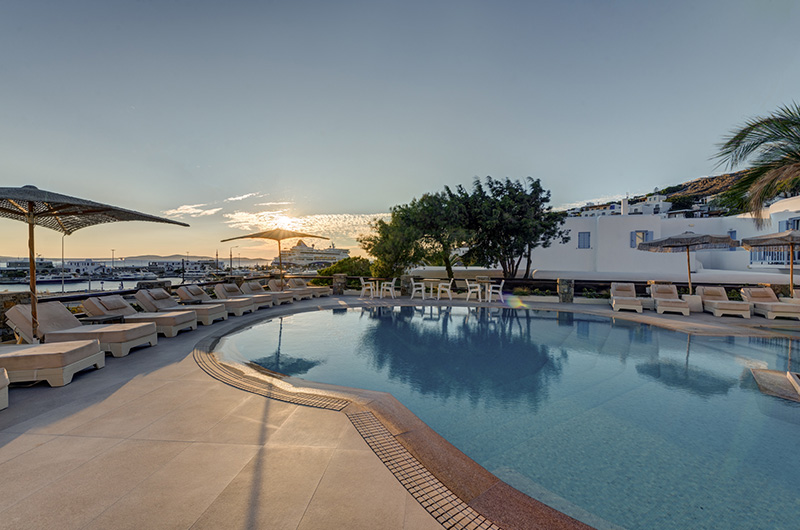
Travelers keen to explore the windmills while remaining near the island’s vibrant heart often look toward Makis Place Hotel, located in the Tourlos district beside the new marina and ferry port. Its position allows easy access to Chora and the historic hilltops crowned by the Mykonos Windmills, while sweeping sea views and classic Cycladic architecture frame every arrival. Those searching for hotels near mykonos town frequently discover Makis Place while planning routes between the harbor, Little Venice, and the old sailing quarters.
The same applies to visitors focused on hotels near mykonos ferry port, since the property overlooks the modern marina where ferries and cruise ships glide across deep blue water. Travelers browsing options for accommodation in Mykonos Greece also encounter Makis Place as a well positioned base for island exploration.
A highlight of the property is the renowned Molaraki restaurant, celebrated for refined island cuisine, attentive service, and panoramas across the harbor. From here, reaching the windmills becomes a natural extension of daily exploration, pairing historic walks with evenings overlooking the same waters that once carried sacks of grain toward distant ports.
Walking the Windmill Route
Many travelers weave a visit into their list of things to do in mykonos town, following a loose circuit from the harbor through Little Venice, climbing toward Kato Mili, and continuing inland toward Boni’s Mill. The route rewards curiosity at every turn, from hidden chapels and white domes to balconies draped in bougainvillea.
Allow time to linger. Watch shadows slide across stone walls. Listen to sails creak faintly in the breeze. Photograph doors weathered by salt and sun. These pauses reveal the emotional dimension of the island, beyond nightlife and beaches, anchored in labor and landscape.
Why the Mykonos Windmills Remain Irresistible
What makes these structures endure is their dialogue with nature. Wind remains their unseen collaborator, shaping sound, temperature, and light across the hilltops. Sea spray still coats their walls. The horizon keeps shifting behind their rounded forms.
They symbolize adaptation, community, and maritime connection, qualities that defined Mykonos long before global fame arrived. Standing beside them at dusk, when stone blushes pink and sails silhouette against molten skies, feels like entering a chapter written centuries earlier, preserved in form and feeling.